
Bishops Guard Unity in the True Faith
Updated: May 25
Homily for the Sixth Sunday after Pascha (Sunday of the Holy Fathers)
Acts of the Apostles 20:16-18, 28-36…………….John 17:1-13
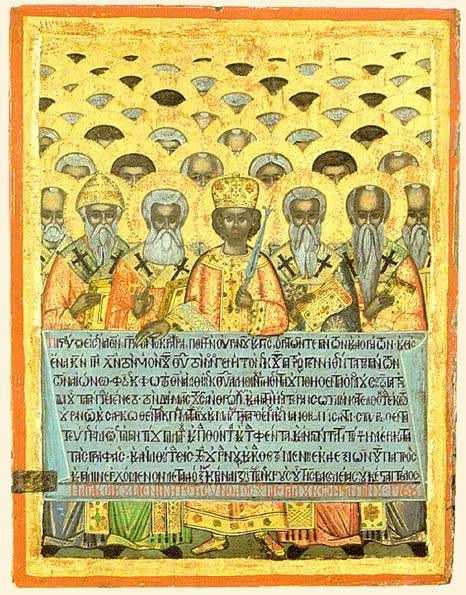
The Scripture readings for this Sunday’s commemoration of the Holy Fathers of the First Ecumenical Council call our attention to three foundational elements of the Christian Church: Unity, True Doctrine, and Bishops.
These three elements stand at the heart of the First Ecumenical Council, which convened in the Byzantine (now Turkish) city of Nicaea in the year 325 by order of Emperor Constantine the Great. Disunity in the Church, newly-legalized and rapidly growing in numbers and influence, posed a threat to the unity of the Roman Empire. To deal with this problem, the emperor called all the bishops of the world (the “ecumene”) for a synod to discuss (or debate) and define essential Christian doctrine.
Three-hundred-eighteen bishops, leaders of Christian communities stretching from Greece to Libya around the Mediterranean and eastward into Mesopotamia and Persia, as well as five bishops from the Western Empire and two priests representing the Pope of Rome, made the long and difficult journey.
The principal issue they had to confront was whether Jesus Christ was actually God, equal to the Father, or whether He was a created being given special power and status by God. Arius, a priest from Alexandria, claimed that Jesus was inferior to God the Father—that He was the greatest of creatures, chosen or sent by God to do God’s work on earth. According to Arius, there was a time when Jesus did not exist, and He was not one in being or essence with God the Father.
The holy fathers of the First Ecumenical Council rejected Arianism and composed the core of what we now know as the Nicene Creed. The Second Ecumenical Council, held in Constantinople in 381, completed the Creed by elaborating the identity and role of the Holy Spirit. And in every Divine Liturgy, as well as in various other services, we recite the Creed to remind ourselves of the true belief that unites us with God and with one another.
We have to do this because throughout Christian history people have thought that they understood God better than the Apostles and the Church. Arianism didn’t die after the Council. At least two emperors and many bishops and priests held onto it for many years. Along with many other heresies, Arianism persists to this day in various Christian groups. Originating in the privatization of faith rather than the collective inspired wisdom of the Church, such heretical beliefs produce some bizarre results, such as when a Baptist preacher claimed recently that Donald Trump knows the Bible better than Pope Leo XIV.
In contrast, the kontakion of today’s celebration brings together the themes from today’s Scripture selections: “The Apostles’ preaching and the Fathers’ teaching established in the Church a single and unified faith. Wherefore, this Church, robed in the truth of a heaven-inspired theology, explains and declares with certainty the great mystery of Christ.”
Because Christ is a mystery—God and man, begotten of the Father and born of a virgin, killed and resurrected—we need theology to explain and declare true belief so that Christians can be united as Christ desires. We find the truth in the preaching of the Apostles and the teaching of the Fathers; that is, in the Church, not in private imaginations or in personal cults.
Some people might wonder why we don’t talk about the authority of the Scriptures. It’s because the preaching of the Apostles and the teaching of the earliest Fathers (bishops) precedes the New Testament. At the time of Jesus and the Apostles, “the Scriptures” meant the Old Testament. We actually learn about the founding of the Church in the first Christian Scriptures, the Letters of St Paul and the Acts of the Apostles. Then the Gospels, the story of the life and works and teachings of Jesus, were written. Finally, at some time before the First Ecumenical Council, the canon or official listing of the books of the New Testament, was established. The Bible comes from the Church, not the Church from the Bible.
This doesn’t mean that we disregard Scripture. It does mean that we regard Scripture as a part of the preaching of the Apostles and the teaching of the Fathers, not as apart from them.
For example, today’s reading from the Gospel of John seems to give us the innermost thoughts of Jesus. That seems impossible for anyone to know, so it’s obviously a teaching and preaching strategy. John wants us to know that Jesus desires unity in faith so that people’s joy can be complete because they know God by knowing Jesus. Jesus affirms his unity with the Father “before the world existed” (a phrase that is echoed in the Creed). And He prays the ultimate prayer for unity: that the Church may be one just as Jesus and the Father are one. Christ’s internal discourse teaches that the Church continues the work given by God to Jesus, because the Church is in the world, even though Jesus is not physically in the world. That work is to make God’s name known in the world and to glorify Christ in the Church. This passage shows us that the unity of the Church mirrors the unity of God.
In the Acts, St Paul meets with the priests and bishops of Ephesus in a synod to warn them that they must take care of the Church and guard it, using sheep-herding images of the people as the “flock,” which savage wolves will attack for selfish reasons, even from among the shepherds themselves. He also introduces the concept of bishops, using the word “episkopoi.” It literally means “overseer,” but has developed into such words as episcopus, obispo, eveque, vescovo, and, of course, bishop. He says that bishops must support the weak by working and not by coveting riches and fine clothing. And, finally, he models leadership in the Church by praying with them—another sign of unity.
Today we rejoice in the enduring work of the holy bishops of the First Ecumenical Council, our faithful shepherds who worked to preserve unity and teach true doctrine, building on the preaching of the Apostles and the teaching of the Fathers to declare and explain the great mystery of Christ, whom we praise and glorify with the Father and the Holy Spirit, One God, now and ever and to ages of ages. Amen.


